How our schools work
My kids recently asked, “Dad, if you win, can you make recess longer? And can school start later?”
That led to a conversation about what a Board of Education member can actually do. I realized I had never really explained to them how our school district works. And, come to think of it, the school district and the BoE were always a big black box to me, too, until I spent more time digging in over the past few years.
I put this page together because the more we all understand — kids and grown-ups alike — the more productive our conversations about Montclair’s schools can be.
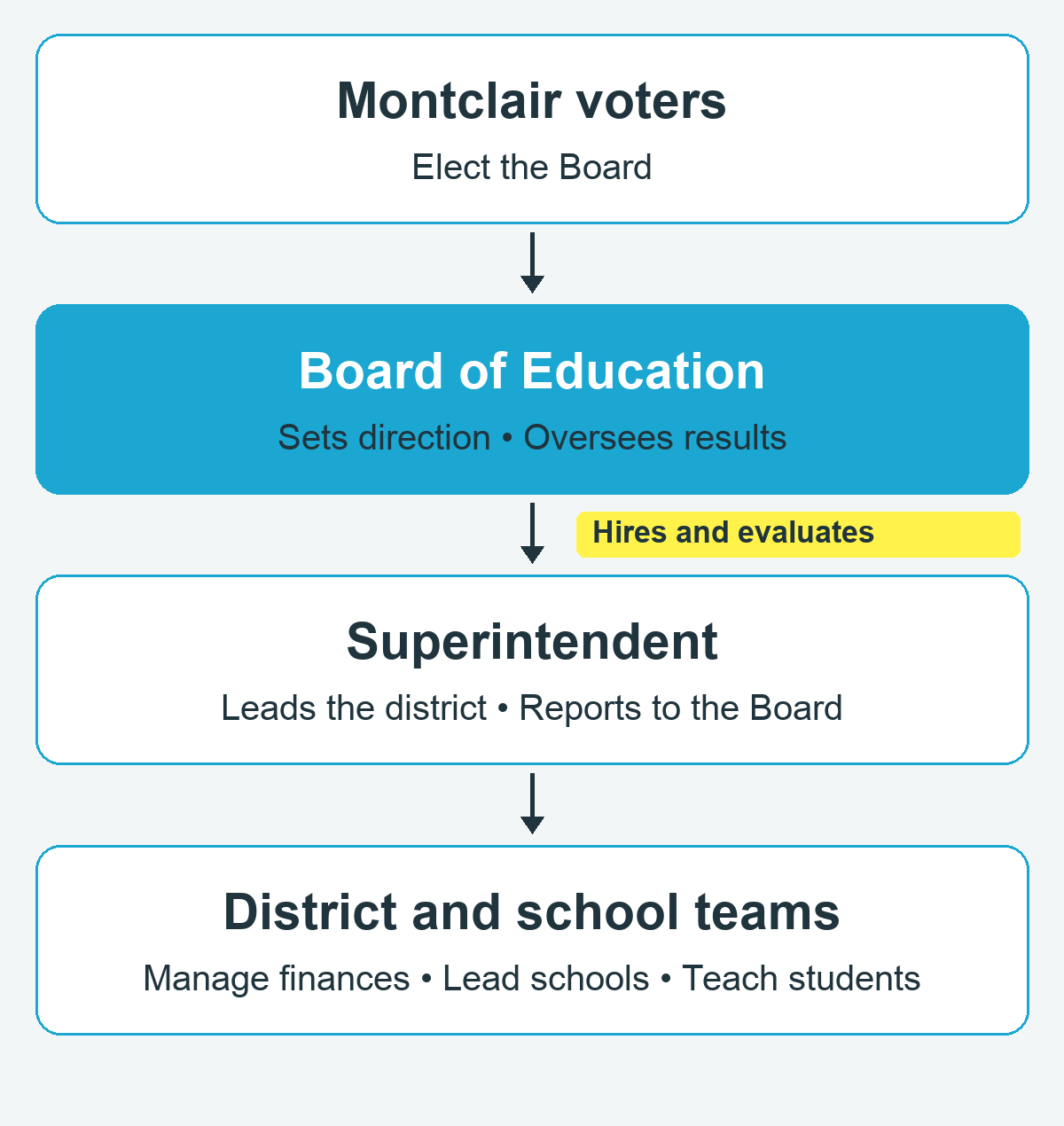
Who does what?
The Board sets direction and provides oversight.
Montclair voters elect nine Board members. Together, they hire and evaluate the superintendent, approve the budget and district policies, and oversee the district’s performance.
The Board acts collectively. An individual member can ask questions, raise concerns, and advocate for changes, but cannot independently direct district employees or change how a school operates.
The superintendent leads the district.
The superintendent is responsible for running the school system: leading staff, recommending plans and investments, carrying out Board policies, and reporting on results.
The business administrator manages the finances.
The business administrator leads budgeting, accounting, purchasing, payroll, and financial reporting. If you think in business terms, the superintendent’s role is similar to a CEO and the business administrator’s to a CFO. Their shared purpose here is to serve students.
Educators and staff make it happen.
Principals lead schools. Teachers and staff teach students, provide support, and manage the daily work of education. Board members should understand that work and ask informed questions while respecting those responsibilities.
About Montclair’s Board · New Jersey’s guide to district responsibilities · Business Office
Where does the money come from?
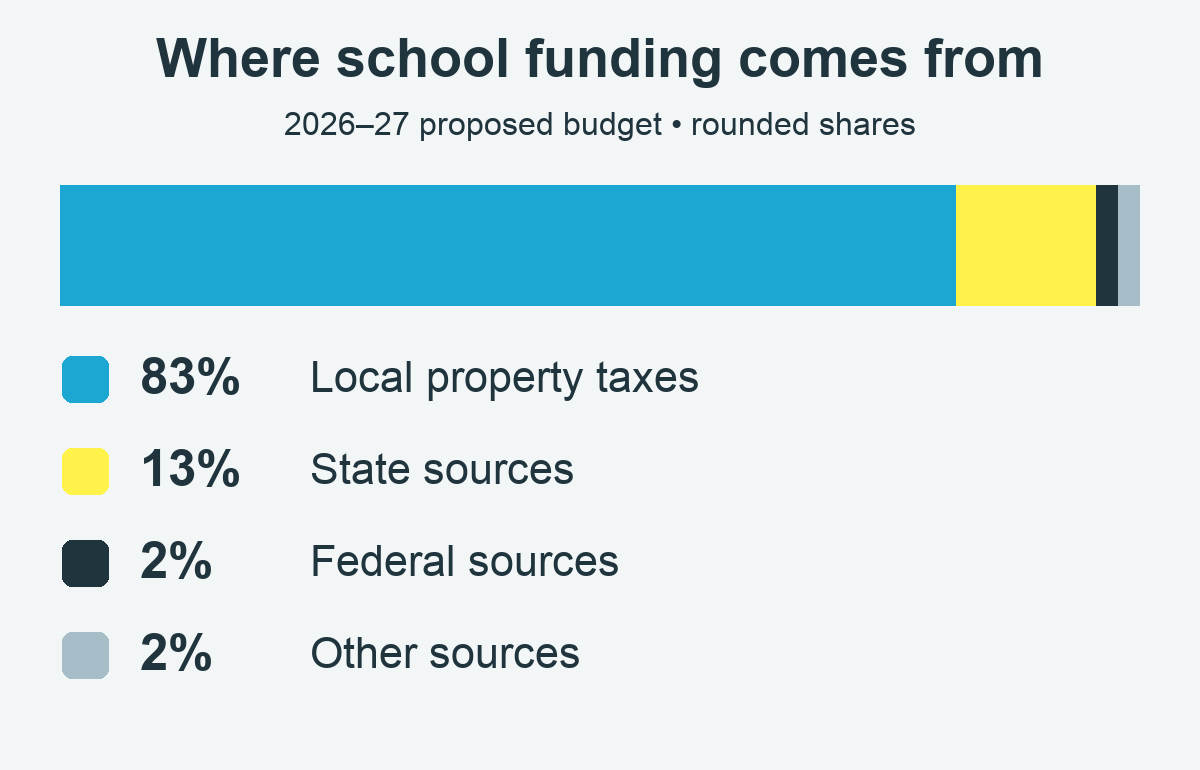
Most of Montclair’s school funding comes from local property taxes.
83% · Local property taxes
13% · State sources
2% · Federal sources
2% · Other sources
These percentages describe school funding—not how your entire property-tax bill is divided. One of the reasons our taxes are so high — and yet our schools are not “over-funded” — is because nearly all the revenue from the district in Montclair comes from Local Property taxes. If you hear folks talking about the “state funding formula”, this is why! There are other districts in NJ that receive more money from the state. The Board of Ed doesn’t control that formula, it’s a state issue.
2026–27 proposed budget, April 28, 2026. Rounded to whole percentages. State sources include preschool carryover; other sources include miscellaneous revenue, fund balance, and transfers. Internal transfers are excluded to avoid double counting.
Where does the money go?
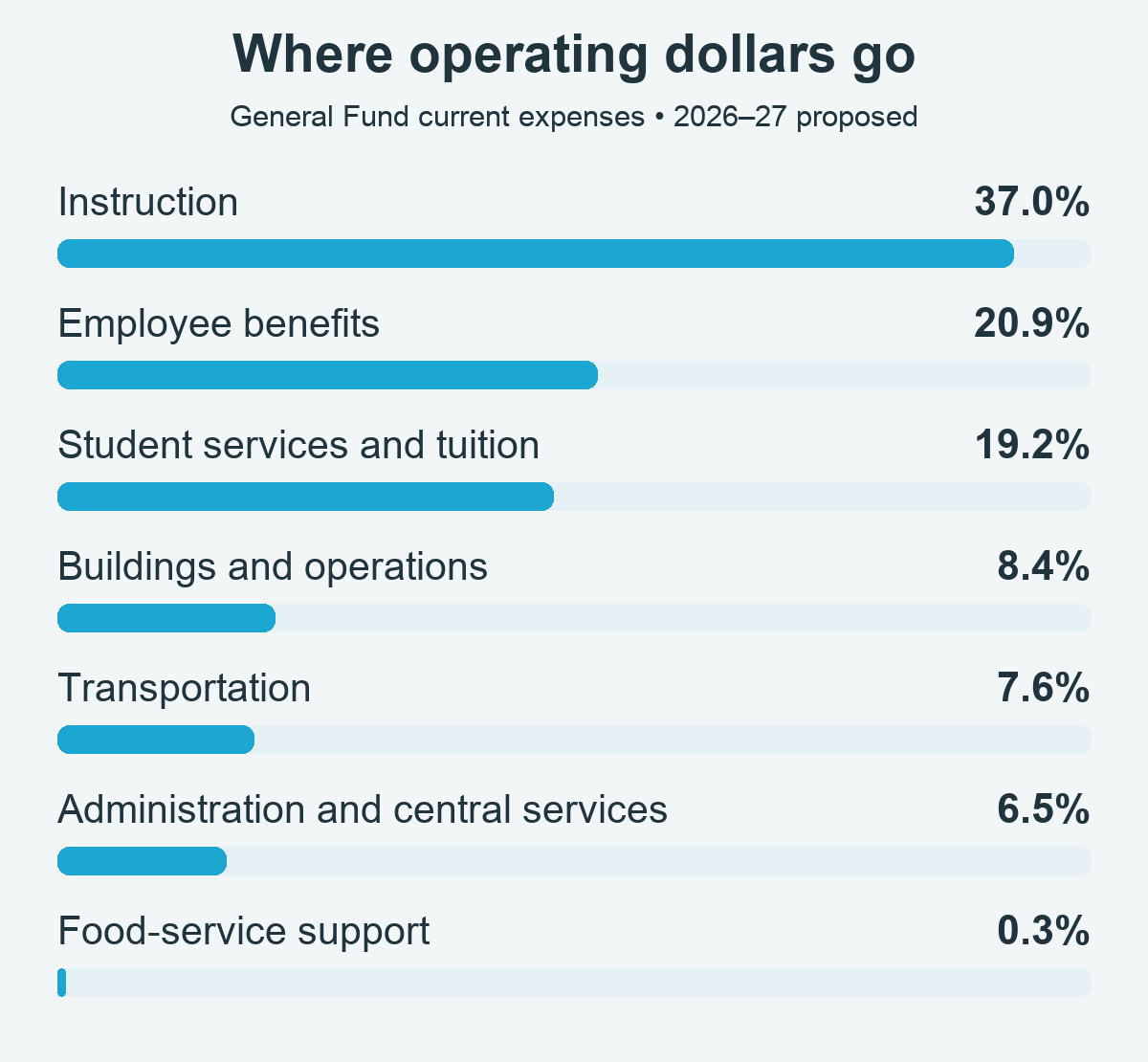
School spending supports people, programs, buildings, and services.
General Fund operating expenses
37.0% — Instruction
20.9% — Employee benefits
19.2% — Student services and tuition
8.4% — Buildings and operations
7.6% — Transportation
6.5% — Administration and central services
0.3% — Food-service support
Salaries are included within the service categories; benefits appear separately.
This view covers General Fund current expenses, excluding capital spending, restricted grants, and debt repayment. Percentages are rounded. Source: April 28, 2026 proposed budget for 2026–27.
Where should I take a question?
About your child’s classroom
Start with the teacher. If the concern remains unresolved, follow the district’s process through the principal and district administration.
About district policy, spending, or priorities
Follow Board agendas, attend meetings, and share your perspective with the Board.
Learn about Board meetings and the district’s communication process →
About my approach as a candidate
Please reach out. I want to hear what you think.
Better information helps all of us.
We will not agree on every decision. But we should be able to understand who is responsible, what information they considered, and whether the decision is working.
That is the kind of Board service I want to provide.
What should oversight look like?
The Board needs to understand the information it receives, ask questions when something is unclear, and follow up on the answers.
Shifting from “how the district works” into how I, as a candidate, feel about oversight —- here are two examples of what I believe that should mean in practice.
Follow the finances throughout the year.
Approving an annual budget is the beginning of the work. The Board should regularly see what the district planned to spend, what it has spent, what it still owes, and where the administration now expects to finish the year.
Those are different things. Spending can look low because a bill has not arrived or a major expense comes later. A useful report should make those differences clear—and explain when the outlook changes.
Follow investments through to student learning.
When the district invests in a curriculum or program, the Board should understand what it is intended to improve and how progress will be measured.
A reading investment should come with a clear starting point, support for teachers, and regular updates on student growth. The Board should ask whether implementation is on track, which students are benefiting, and what needs to change.
That gives educators room to do their work while giving the Board a way to assess whether the district is making progress.